A house in Meda
Meda sits in Brianza, the stretch of country north of Milan that furnished the great houses of Europe for two centuries. The workshops here made the chairs, the cabinets and the gilded frames that went to Turin, Vienna, Paris and beyond; the antiques trade followed naturally, because the people who make furniture are also the people who know how to mend it, and the people who know how to mend it are the ones who recognise what is worth keeping.
The building Urnica occupies has sold antiques since 1958. For nearly seventy years it was a place where architects and decorators came to find pieces for the houses they were furnishing, where things were restored on the premises, and where the difference between an original surface and a later one was a matter of daily conversation rather than a footnote. We are the next chapter of that story, not a new one.
What we promise
Every piece in the house is catalogued the same way: what it is, where it has been, and exactly what has been restored. Where a crest has been regilded, we say so. Where a plate has been replaced, the entry says so. Where we do not know something — a maker, a date, a previous owner — we say that too, rather than fill the gap with a flattering guess. If something is not mentioned, it is original.
Prices are on every entry. The range is wide on purpose, from decorative twentieth-century pieces in the old manner to genuine eighteenth- and nineteenth-century work, and we would rather you understood which is which than paid for the wrong one.
The catalogue
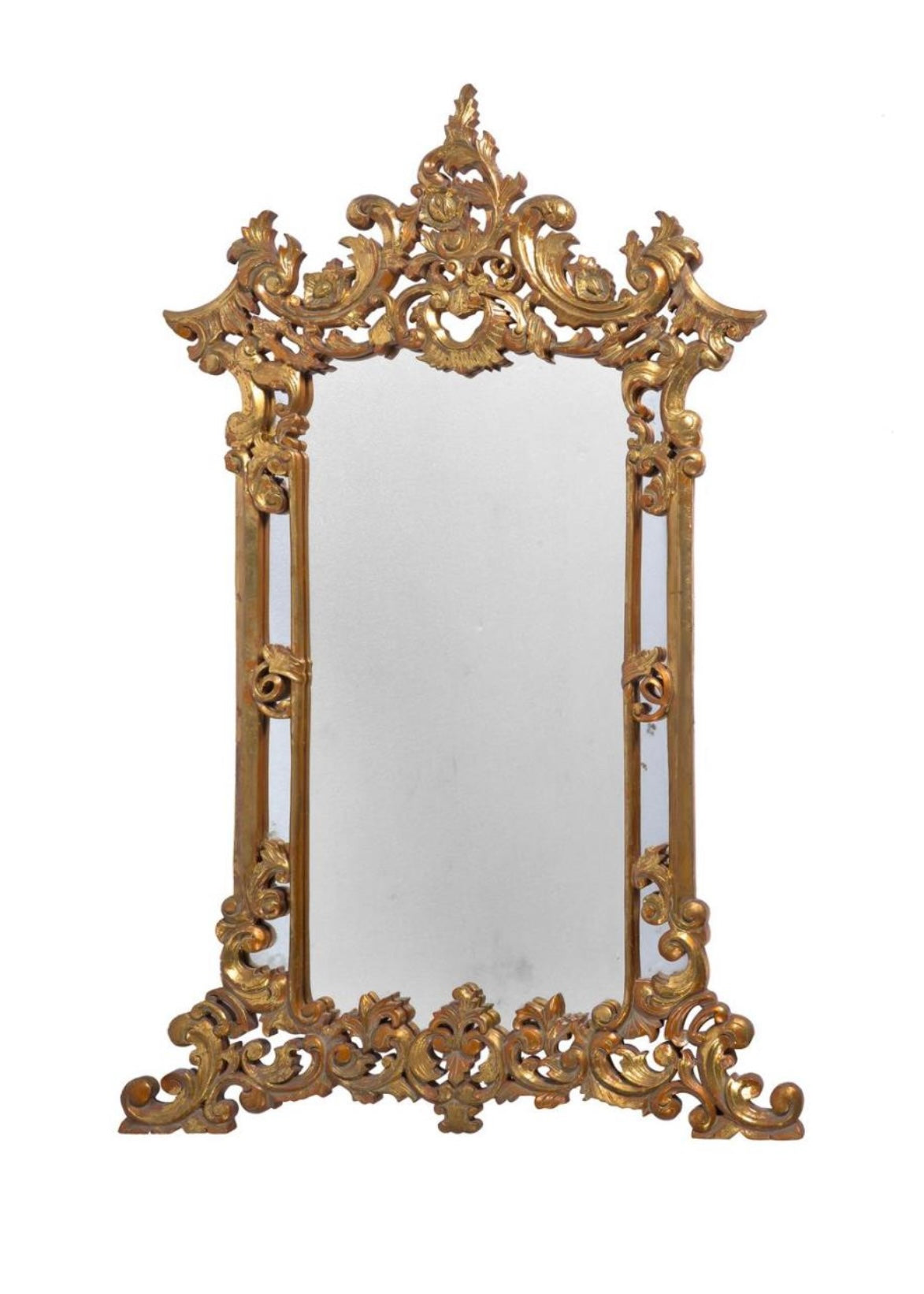
The catalogue is arranged in six categories, and every piece can be searched by epoch, origin and material. Mirrors are hung as they would have been: in pairs, over consoles, opposite windows. As the building is restored, pieces will be photographed in its own daylight so that what you see on this site is what you would see standing in it.
What we have not sold stays in the house. What we have sold stays on the record, because a house that remembers what passed through it is worth more to the next buyer than one that forgets.